On its way to us, CMBcosmic microwave backgroundThermal radiation released about 370,000 years after the Big Bang, now at 2.7255 K and peaking near 160 GHz. Its temperature and polarisation anisotropies, at the 10−5 level, constrain the content and geometry of the Universe. light is deflected by all the mass it passes, by a few arcminutes in patterns coherent over degrees. The deflections change the CMB's statistics in a known way, so they can be decoded into a map of the projected mass, mostly between redshiftsredshiftz = λobserved/λemitted − 1, the stretching of light by cosmic expansion (or by recession). For distant sources it stands in for distance and look-back time: z ≈ 1 is about 8 Gyr ago, z ≈ 10 about 13.3 Gyr. 0.5 and 5, lensing a source at a precisely known distance.
- Measures
- Lensing power spectrum of the CMB
- When
- z = 0.5–5
- Constrains
- on its own
- S8 amplitude of structure (σ8, S8)
- with other probes
- H0 Hubble constant
- Ωm matter density
- Σmν sum of neutrino masses
Get the data
- ACT DR6 lensing (LAMBDA) (opens in a new tab)
Lensing map, power spectrum and likelihood
- ACT + SPT lensing (LAMBDA) (opens in a new tab)
The joint ACT, SPT and Planck lensing likelihood and chains
- Planck PR4 lensing (GitHub) (opens in a new tab)
PR4 lensing likelihoods, maps and chains
- Planck Legacy Archive (opens in a new tab)
Planck 2018 lensing map and likelihood
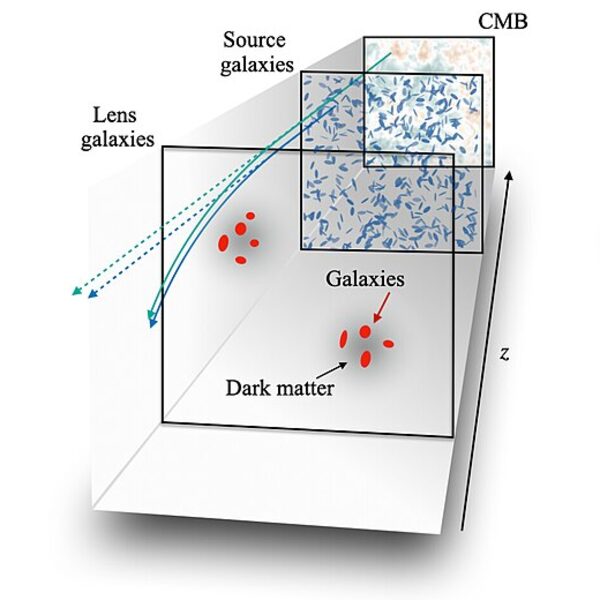
How CMB light is bent by matter on its way, schematic
NOIRLab/NSF/AURA/Y. Omori · CC BY 4.0 · Source (opens in a new tab)
The physics
Structures between us and the last-scattering surface deflect CMB photons. The deflection is the gradient of the lensing potentiallensing potentialϕ, the projected gravitational potential of all the mass between us and the CMB; its gradient is the deflection and its Laplacian the convergence κ, the projected density. Its power spectrum, ϕϕ (or κκ), at lensing multipoles L, is what CMB lensing likelihoods hold. φ, the projected gravitational potential, so the temperature seen at position θ on the sky comes from a nearby position:
T(θ) → T(θ + ∇φ)
typical deflections are about 2 arcminutes, coherent over degrees
Lensing conserves surface brightness, so it would not change a uniform sky, but it distorts the CMB's spots. It smooths the acoustic peaks in the power spectrum, adds power on the smallest scales, turns some E-mode polarisationE-modesThe gradient-like component of CMB polarisation, produced by velocity gradients in the plasma at last scattering and, on the largest scales, by scattering after reionisation. It is much fainter than the temperature signal. into B modesB-modesThe curl-like component of a polarisation or shear pattern. In CMB polarisation on degree scales, primordial gravitational waves from inflation would produce it; its amplitude is quoted as the tensor-to-scalar ratio r. Lensing by large-scale structure makes almost none in galaxy shapes, so lensing surveys use their B-modes as a null test., and, most usefully, correlates large-scale gradients with small-scale structure. That correlation, a four-point function of the map, lets φ be reconstructed.
The source is a single surface at a precisely known distance, which removes the uncertainty in source redshifts that galaxy lensing has, and most of the signal comes from linear scales. The amplitude of the lensing spectrum measures the amplitude of matter fluctuations; it also breaks the degeneracy in the primary CMB between that amplitude and the optical depthoptical depth to reionisationτ, the fraction of CMB photons scattered by free electrons after the Universe reionised, about 0.05. It damps the small-scale spectra and adds a polarisation bump at ℓ < 10, so only full-sky large-scale polarisation (from Planck) measures it; ground-based fits take it as a prior.. Because massive neutrinosneutrinoA nearly massless, neutral particle that interacts only weakly, so it escapes dense sources and crosses the Universe undeflected. High-energy astrophysical neutrinos point back to where cosmic rays are accelerated. suppress the growth of structure, it is one of the main handles on the sum of neutrino masses.
How it is measured
Reconstruction needs maps with arcminute resolution and low noise. Quadratic estimatorsquadratic estimatorThe standard way to reconstruct CMB lensing: lensing couples Fourier modes that are independent in an unlensed sky, so products of pairs of filtered temperature or polarisation maps recover the lensing potential. Its noise and biases are worked out with simulations. combine pairs of temperature and polarisationpolarimetryMeasuring the polarisation of incoming radiation. It encodes magnetic-field geometry, scattering and emission mechanisms; in the CMB it separates E- and B-mode patterns. maps to estimate φ; the EB combination, from polarisation, is cleanest because the CMB itself has almost no B modes. Planck gives the full sky at modest noise; ACT and SPT go deeper over part of it.
The biases are known and must be subtracted: noise and the Gaussian part of the CMB add power to a reconstructed map, and on small scales extragalactic foregroundsforegroundsEmission between us and the signal of interest. For the CMB: Galactic synchrotron, free–free and dust on large scales, and on small scales the cosmic infrared background, radio and infrared point sources and the Sunyaev–Zel'dovich effect. Component separation uses their different spectra across frequencies to remove them., such as galaxy clustersgalaxy clusterThe most massive gravitationally bound structures, about 1014–1015 M☉, with hundreds to thousands of galaxies in hot, X-ray-emitting gas. Their number against mass and redshift depends steeply on σ8 and Ωm, which makes cluster counts a probe of the growth of structure. and dusty galaxies, imitate lensing. Polarisation-only analyses avoid most of the foregrounds, at the cost of more noise.
Current results
- ACT, SPT and Planck lensing in one likelihood, signal to noise 61 (Qu et al. 2026)
- σ8(Ωm/0.3)0.25 = 0.825 (+0.015, −0.013)
- The same with DESI BAO
- σ8 = 0.829 ± 0.009
- Amplitude of the joint lensing spectrum relative to the P-ACT ΛCDM fit
- 1.025 ± 0.017
- How far KiDS, DES and HSC lensing, reanalysed uniformly, sit below ACT and Planck lensing in S8
- 1.7σ–2.1σ
ACT DR6, Planck PR4 and SPT-3G's polarisation-only MUSEMarginal Unbiased Score ExpansionA Bayesian method that estimates parameters, here band powers, straight from maps while marginalising over the unlensed CMB and the lensing field, using simulations. SPT-3G used it to measure the lensing and unlensed E-mode spectra from polarisation alone. analysis each measure the lensing spectrum at a signal to noise of about 40. In one likelihoodlikelihoodThe probability of the measured data given a model's parameters, as code a sampler such as Cobaya or CosmoSIS calls at each step. A cosmology dataset usually ships one: its measured statistic, a covariance matrix and the rule for comparing them with a prediction. they reach 61, with amplitude 1.025 ± 0.017 relative to the P-ACT ΛCDMΛCDMThe standard cosmological model: a flat universe with dark energy as a cosmological constant (Λ), cold dark matter and ordinary matter, fit by six parameters. fit and σ8(Ωm/0.3)0.25σ8Ωm0.25The mix of clustering amplitude σ8 and matter density Ωm that the CMB lensing spectrum measures best: like S8, but with exponent 0.25. ACT writes it σ8(Ωm/0.3)0.25, about 0.82; Planck and SPT papers often drop the 0.3, which makes it smaller by 0.30.25 ≈ 0.74, about 0.60. = 0.825 (+0.015, −0.013); with DESI BAObaryon acoustic oscillationsA preferred separation of about 150 Mpc (comoving) in the galaxy distribution, imprinted by sound waves in the early Universe. Measuring it at many redshifts traces the expansion history like a standard ruler., σ8S8S8 = σ8 (Ωm/0.3)0.5, the amplitude of matter clustering (σ8, the fluctuation in 8 h−1 Mpc spheres) combined with the matter density Ωm in the way weak lensing measures best. Lensing surveys find values around 0.76–0.82; the CMB predicts about 0.83, and the size of the gap is the "S8 tension". KiDS also quotes Σ8 = σ8(Ωm/0.3)α, with α fitted to the direction its own data constrain best (0.58 for KiDS-Legacy). = 0.829 ± 0.009.
SPT-3G D1's quadratic estimator, from temperature and polarisation together, gives σ8Ωm0.25 = 0.6046 ± 0.0096 on its own. Reanalysed with uniform assumptions, KiDS, DES and HSC galaxy lensing give S8 lower than ACT and Planck lensing by 1.7σ–2.1σ.
Experiments and datasets
Full sky
ESA space telescope at L2, 2009–2013
Lensing reconstructed from the PR4 maps
Temperature and polarisation, the whole sky
Wide and deep
6 m telescope at 5,190 m on Cerro Toco, Chile
A lensing map over 9,400 deg2
From the DR6 temperature and polarisation maps
ACT DR6 lensing2023
Polarisation
10 m telescope at the South Pole, SPT-3G camera
The SPT-3G Main field
Polarisation only, analysed with MUSE
Together
ACT, SPT and Planck lensing spectra
A joint likelihood
With their cross-covariance
ACT + SPT + Planck lensing2025
σ8(Ωm/0.3)0.25 = 0.825 (+0.015, −0.013)
Other datasets
- SPT-3G D1 lensingData not yet public
- ACT DR6 + Planck PR4 lensing
Earlier: Planck 2018 lensing, Planck 2015 lensing, SPT-3G 2018 lensing, ACT DR4 lensing
Open questions
Amplitude of structure (S8)
Lensing surveys have tended to find matter less clumpy than the CMB predicts. The final DES 3×2pt3×2ptA joint analysis of three two-point correlation functions from one imaging survey: cosmic shear (shapes × shapes), galaxy clustering (positions × positions) and galaxy–galaxy lensing (positions × shapes). Together they separate how matter clusters from how galaxies trace it. gives S8 = 0.789 ± 0.012, 2.6σ below the combined CMB, but KiDS-Legacy, at 0.815 (+0.016, −0.021), agrees with Planck, and eROSITA clusters give a higher 0.86 ± 0.01. The tension is not consistent across probes.
ProbesWeak gravitational lensingGalaxy clusteringGalaxy clustersCMB gravitational lensing
Neutrino mass
Massive neutrinos slow the growth of structure, so cosmology weighs them. DESI BAO with the CMB sets Σmν < 0.064 eVelectronvoltThe energy an electron gains across 1 volt, 1.602 × 10⁻¹⁹ J. High-energy astronomy labels photons by energy: optical light is about 1.7–3.1 eV, X-rays 0.1–100 keV, gamma rays from about 100 keV to beyond 100 TeV. A 1 keV photon has wavelength 1.24 nm. (95%) in ΛCDM, close to the minimum of about 0.06 eV that neutrino oscillations require. The bound loosens to 0.16 eV if dark energydark energyWhatever drives the accelerating expansion of the Universe, about 69% of its energy density today. Measured through expansion history (supernovae, BAO) and the growth of structure (weak lensing, clustering). evolves.
ProbesBAOCMB temperature and polarisationCMB gravitational lensing
Key papers
- 2026Cosmic Microwave Background (opens in a new tab)
Scott and Smoot · Review of Particle Physics
The standard review; its section on lensing explains the deflections, their effects and the reconstruction.
- 2024The Atacama Cosmology Telescope: A Measurement of the DR6 CMB Lensing Power Spectrum and its Implications for Structure Growth (opens in a new tab)
Qu et al. · ApJ 962, 112
The ACT DR6 lensing power spectrum, and what it says about the growth of structure.
- 2024The Atacama Cosmology Telescope: DR6 Gravitational Lensing Map and Cosmological Parameters (opens in a new tab)
Madhavacheril et al. · ApJ 962, 113
The ACT DR6 lensing map, and parameters from it with BAO.
- 2026Unified and Consistent Structure Growth Measurements from Joint ACT, SPT and Planck CMB Lensing (opens in a new tab)
Qu et al. · Phys. Rev. Lett. 136, 021001
ACT, SPT and Planck lensing in one likelihood, at signal to noise 61.
Sources
- Scott and Smoot, Cosmic Microwave Background (PDG 2026) (opens in a new tab)
- Qu et al. 2025, joint lensing (arXiv) (opens in a new tab)
- Omori et al. 2026 (arXiv) (opens in a new tab)
- Qu et al. 2024 (arXiv) (opens in a new tab)
- Madhavacheril et al. 2024 (arXiv) (opens in a new tab)
Checked 21 November 2026.