Galaxy clustersgalaxy clusterThe most massive gravitationally bound structures, about 1014–1015 M☉, with hundreds to thousands of galaxies in hot, X-ray-emitting gas. Their number against mass and redshift depends steeply on σ8 and Ωm, which makes cluster counts a probe of the growth of structure. are the most massive objects held together by gravity, and how many there are of each mass at each redshiftredshiftz = λobserved/λemitted − 1, the stretching of light by cosmic expansion (or by recession). For distant sources it stands in for distance and look-back time: z ≈ 1 is about 8 Gyr ago, z ≈ 10 about 13.3 Gyr. depends very steeply on how clumpy matter has become. Counting them, and weighing them with weak lensingweak gravitational lensingCoherent distortion of distant galaxy shapes, at the percent level, by mass along the line of sight. Averaged over millions of galaxies it maps dark matter and the growth of structure; it needs exquisite PSF control., measures the amplitude of matter fluctuations and the matter density.
- Measures
- Cluster counts in mass and redshift
- When
- z = 0.1–1.9
- Constrains
- on its own
- Ωm matter density
- S8 amplitude of structure (σ8, S8)
- with other probes
- w0, wa dark energy equation of state
- Σmν sum of neutrino masses
Get the data
- eROSITA-DE DR1 (opens in a new tab)
eRASS1 cluster catalogues and cosmology sample
- SPT at LAMBDA (opens in a new tab)
SPT-SZ and SPTpol cluster catalogues
- ACT at LAMBDA (opens in a new tab)
ACT DR5 SZ cluster catalogue
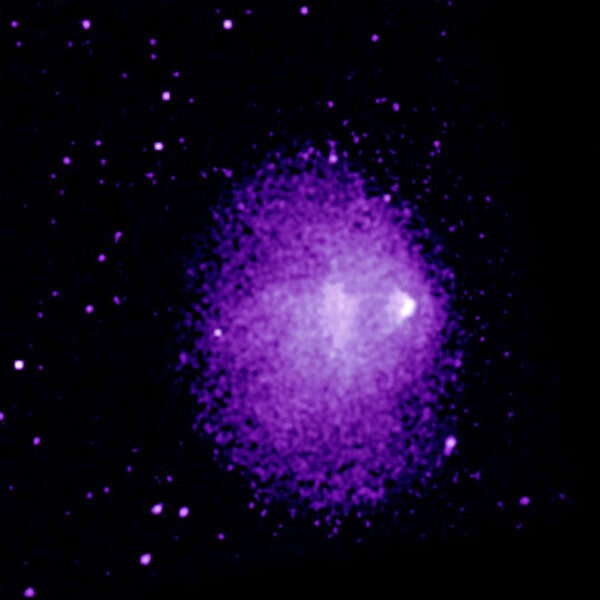
The Bullet Cluster, 1E 0657-56, in X-rays (Chandra)
NASA/SAO/CXC/M. Markevitch et al. · Public domain · Source (opens in a new tab)
The physics
Clusters form from the rarest high peaks of the initial density field, so their number falls off exponentially with mass. A small change in the amplitude of fluctuations, σ8S8S8 = σ8 (Ωm/0.3)0.5, the amplitude of matter clustering (σ8, the fluctuation in 8 h−1 Mpc spheres) combined with the matter density Ωm in the way weak lensing measures best. Lensing surveys find values around 0.76–0.82; the CMB predicts about 0.83, and the size of the gap is the "S8 tension". KiDS also quotes Σ8 = σ8(Ωm/0.3)α, with α fitted to the direction its own data constrain best (0.58 for KiDS-Legacy)., or in the matter density changes the number of massive clusters a lot. Like lensing, cluster counts measure the combination σ8 Ωmα, with α ≈ 0.3–0.5, and their evolution with redshift follows the growth of structure.
Most of a cluster's ordinary matter is hot gas, at 107–108 K, which gives three ways to find clusters. The gas shines in X-rays. Its electrons scatter CMBcosmic microwave backgroundThermal radiation released about 370,000 years after the Big Bang, now at 2.7255 K and peaking near 160 GHz. Its temperature and polarisation anisotropies, at the 10−5 level, constrain the content and geometry of the Universe. photons to higher energies, the thermal Sunyaev–Zel'dovich effectSunyaev–Zel'dovich effectA distortion of the CMB by hot electrons. In galaxy clusters, inverse Compton scattering shifts photons to higher energy: a decrement below about 220 GHz and an excess above. Its surface brightness does not dim with redshift, so millimetre surveys find clusters at all distances with a nearly mass-limited selection., which leaves a shadow in millimetre maps whose depth does not fade with distance:
y = ∫ kB Teme c2 ne σT dl
the Compton parameter: electron pressure integrated along the line of sight
And the member galaxies show up as overdensities of red galaxies in optical imaging. Each method finds clusters by an observable, not by mass.
How it is measured
The limiting systematic is the relation between the observable used to find a cluster (X-ray luminosity, SZ signal, number of galaxies) and its mass, which the theory predicts counts for. It needs percent-level accuracy. The most reliable calibrationcalibrationRemoving instrument signatures and putting data in physical units. For images: subtracting bias and dark current, dividing by the flat field (pixel-to-pixel sensitivity), correcting non-linearity and fitting the astrometric solution. For CMB maps: the gain of each detector and channel; CMB likelihoods fit the small calibration differences between spectra as nuisance parameters. For supernovae: putting every survey's photometry on one magnitude system, so distances from different telescopes can be compared. now uses weak lensing: the shear of background galaxies around many clusters, stacked, measures their average mass.
The selection has to be modelled too: which clusters a survey could detect at each mass and redshift. Baryonic physics changes the mass profiles of haloes, which affects both the masses and the theory's predictions.
Current results
- 5,259 eROSITA clusters with DES, KiDS and HSC lensing (Ghirardini et al. 2024)
- S8 = 0.86 ± 0.01
- The same, with Ωm = 0.29 (+0.01, −0.02)
- σ8 = 0.88 ± 0.02
- 1,005 SPT clusters with DES and Hubble lensing, Ωm = 0.286 ± 0.032 (Bocquet et al. 2024)
- σ8 = 0.817 ± 0.026
eROSITA's first all-sky surveyall-sky surveyObserving the entire celestial sphere to uniform depth, typically by scanning great circles or tiling fields. Produces catalogues and maps others select targets from. gives 5,259 clusters over 12,791 deg2square degreeUnit of solid angle: one degree by one degree on the sky. The whole sky is about 41,253 deg2; the full Moon covers about 0.2 deg2. of the western Galactic hemisphere, calibrated with DES, KiDS and HSC lensing: Ωm = 0.29 (+0.01, −0.02), σ8 = 0.88 ± 0.02 and S8 = 0.86 ± 0.01. That is higher than galaxy lensing finds, so the lower S8 of lensing surveys is not seen in every probe.
SPT's 1,005 clusters over 5,200 deg2, calibrated with DES and Hubble lensing, give Ωm = 0.286 ± 0.032 and σ8 = 0.817 ± 0.026. ACT's DR5 catalogue has 4,195 confirmed clusters to z = 1.91. Planck's 439 SZ clusters gave σ8 in varying degrees of tension with its primary CMB, depending on the mass calibration.
Experiments and datasets
X-rays
eROSITA
X-ray telescope on the SRG mission, at L2 since 2019
Imaging all-sky survey up to 10 keV
5,259 clusters over 12,791 deg2
The western Galactic hemisphere, weighed with DES, KiDS and HSC lensing
eRASS1 clusters
S8 = 0.86 ± 0.01
SZ, South Pole
10 m telescope at the South Pole
1,005 clusters over 5,200 deg2
Weighed with DES and Hubble lensing
SPT clusters with DES and HST lensing
σ8 = 0.817 ± 0.026
SZ, Atacama
6 m telescope at 5,190 m on Cerro Toco, Chile
4,195 confirmed clusters
To z = 1.91
ACT DR5 SZ clusters
Other datasets
Earlier: Planck SZ clusters
Open questions
Amplitude of structure (S8)
Lensing surveys have tended to find matter less clumpy than the CMB predicts. The final DES 3×2pt3×2ptA joint analysis of three two-point correlation functions from one imaging survey: cosmic shear (shapes × shapes), galaxy clustering (positions × positions) and galaxy–galaxy lensing (positions × shapes). Together they separate how matter clusters from how galaxies trace it. gives S8 = 0.789 ± 0.012, 2.6σ below the combined CMB, but KiDS-Legacy, at 0.815 (+0.016, −0.021), agrees with Planck, and eROSITA clusters give a higher 0.86 ± 0.01. The tension is not consistent across probes.
ProbesWeak gravitational lensingGalaxy clusteringGalaxy clustersCMB gravitational lensing
Key papers
- 2026Dark Energy (opens in a new tab)
Weinberg and White · Review of Particle Physics
The standard review; its section on clusters explains the counts, the mass calibration and the selection.
- 2024The SRG/eROSITA all-sky survey: Cosmology constraints from cluster abundances in the western Galactic hemisphere (opens in a new tab)
Ghirardini et al. · A&A 689, A298
5,259 eROSITA clusters, weighed with weak lensing: S8 = 0.86 ± 0.01.
- 2024SPT Clusters with DES and HST Weak Lensing. II. Cosmological Constraints from the Abundance of Massive Halos (opens in a new tab)
Bocquet et al.
1,005 SPT clusters, weighed with DES and Hubble lensing.
- 2021The Atacama Cosmology Telescope: A Catalog of > 4000 Sunyaev-Zel'dovich Galaxy Clusters (opens in a new tab)
Hilton et al. · ApJS 253, 3
The ACT DR5 catalogue of 4,195 confirmed SZ clusters.
- 2016Planck 2015 results. XXIV. Cosmology from Sunyaev-Zeldovich cluster counts (opens in a new tab)
Planck Collaboration · A&A 594, A24
Planck's 439 SZ clusters, and how their mass calibration sets the tension with the CMB.
Sources
- Weinberg and White, Dark Energy (PDG 2026) (opens in a new tab)
- eROSITA (MPE) (opens in a new tab)
- Ghirardini et al. 2024 (arXiv) (opens in a new tab)
- Bocquet et al. 2024 (arXiv) (opens in a new tab)
- Hilton et al. 2021 (arXiv) (opens in a new tab)
- Planck 2015 XXIV (arXiv) (opens in a new tab)
Checked 21 November 2026.