Mass between us and distant galaxies bends their light and distorts their shapes by about 1%. Correlating the shapes of millions of galaxies, sorted by photometric redshiftphotometric redshiftA redshift estimated from a galaxy's brightness in several filters instead of from a spectrum: cheap enough for hundreds of millions of galaxies, but typically uncertain by a few percent in 1 + z, with occasional outliers. Weak-lensing surveys calibrate the redshift distributions against spectroscopic samples., measures how all the matter in front of them is clustered, dark matter included, and how that clustering has grown.
- Measures
- Cosmic shear ξ±(θ) in photo-z bins
- When
- z = 0.1–2
- Constrains
- on its own
- S8 amplitude of structure (σ8, S8)
- with other probes
- Ωm matter density
- w0, wa dark energy equation of state
- Σmν sum of neutrino masses
Get the data
- KiDS data releases (opens in a new tab)
KiDS-Legacy shear catalogue and cosmology products
- DES data releases (opens in a new tab)
Y6 shape catalogue and data vectors
- HSC data releases (opens in a new tab)
PDR3 and the Year 3 shape catalogue
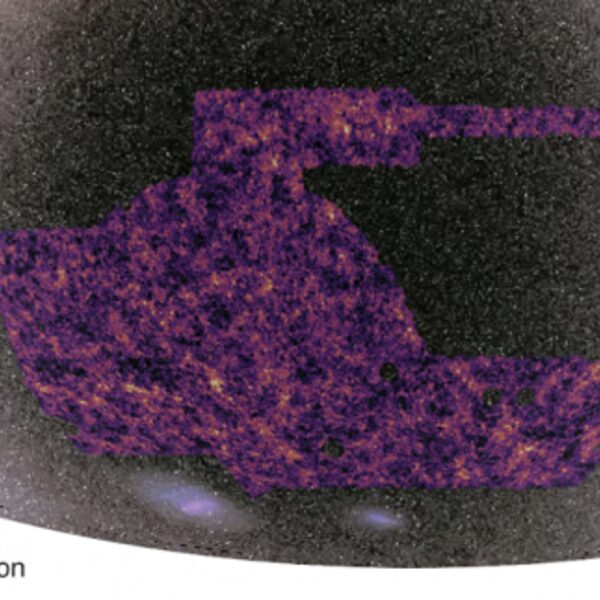
The DES Year 3 dark-matter map from weak lensing
Dark Energy Survey · CC BY-SA 4.0 · Source (opens in a new tab)
The physics
Light passing a mass is deflected, and the deflection varies across the sky, so the image of a background galaxy is magnified and sheared. Large-scale structure shearsweak gravitational lensingCoherent distortion of distant galaxy shapes, at the percent level, by mass along the line of sight. Averaged over millions of galaxies it maps dark matter and the growth of structure; it needs exquisite PSF control. all galaxies behind it coherently, by about 1%. That is far smaller than the spread of galaxies' intrinsic shapes, so the signal is found statistically: in random orientations the intrinsic shapes average away, while the shear does not. The noise falls with the number of galaxies N:
σγ ≈ σe\sqrt N
the shear error from N galaxies with intrinsic ellipticity scatter σe
The correlation of shapes at separation θ, cosmic shear, measures the matter power spectrum projected along the line of sight and weighted by the distances to the lenses and sources. Splitting the source galaxies into bins of photometric redshift adds information on how the clustering grew. The signal scales roughly as σ8 Ωmα with α = 0.3–0.5, so lensing measures best
S8 = σ8 (Ωm/0.3)0.5
Lensing sees all the matter, not only the galaxies, so it has no bias to marginalise. It also depends on the distances, so with supernovae or BAObaryon acoustic oscillationsA preferred separation of about 150 Mpc (comoving) in the galaxy distribution, imprinted by sound waves in the early Universe. Measuring it at many redshifts traces the expansion history like a standard ruler. it tests the expansion history as well as growth.
How it is measured
Cosmic shear needs deep, sharp imaging of thousands of square degreessquare degreeUnit of solid angle: one degree by one degree on the sky. The whole sky is about 41,253 deg2; the full Moon covers about 0.2 deg2. from a stable telescope. Each galaxy's shape is measured after correcting for the blurring by the atmosphere and the optics, the point-spread functionpoint-spread functionThe image a system makes of a point source. Its width (often quoted as FWHM, or half-energy width for X-ray optics) sets the effective resolution; its shape matters for photometry, deblending and weak-lensing shape measurement., which is itself mapped from the stars in each image. Shear calibrationcalibrationRemoving instrument signatures and putting data in physical units. For images: subtracting bias and dark current, dividing by the flat field (pixel-to-pixel sensitivity), correcting non-linearity and fitting the astrometric solution. For CMB maps: the gain of each detector and channel; CMB likelihoods fit the small calibration differences between spectra as nuisance parameters. For supernovae: putting every survey's photometry on one magnitude system, so distances from different telescopes can be compared. is tested on image simulationsimage simulationsSimulated survey images, with galaxies of known shear, blending and observing conditions matched to the data, run through the same pipeline as the real images. They calibrate the multiplicative shear bias and, where galaxies at different redshifts blend, its link to the redshift distributions..
The redshiftredshiftz = λobserved/λemitted − 1, the stretching of light by cosmic expansion (or by recession). For distant sources it stands in for distance and look-back time: z ≈ 1 is about 8 Gyr ago, z ≈ 10 about 13.3 Gyr. distribution of each bin has to be known precisely, since it sets how strongly each bin is lensed. Galaxies that formed near each other are aligned by tidal forces, an intrinsic alignmentintrinsic alignmentGalaxies' shapes lining up with each other and with the surrounding tidal field because they formed together, not because of lensing. It mimics a lensing signal at the percent level, so cosmic shear analyses model it (NLA and TATT are the common models) and marginalise over it. that mimics the signal. On small scales, the effects of baryons, such as gas blown out of galaxies by feedback, change the matter power spectrum and have to be modelled or the scales cut.
Current results
- KiDS-Legacy, the completed 1,347 deg2 survey (Wright et al. 2025)
- S8 = 0.815 (+0.016, −0.021)
- The final DES cosmic shear, Year 6 (DES Collaboration 2026)
- S8 = 0.798 (+0.014, −0.015)
- HSC Year 3 over 416 deg2 (Dalal et al. 2023)
- S8 = 0.776 (+0.032, −0.033)
- How far DES Y6 cosmic shear sits below the Planck, ACT and SPT CMB in S8
- 2.0σ
Earlier lensing surveys found S8S8S8 = σ8 (Ωm/0.3)0.5, the amplitude of matter clustering (σ8, the fluctuation in 8 h−1 Mpc spheres) combined with the matter density Ωm in the way weak lensing measures best. Lensing surveys find values around 0.76–0.82; the CMB predicts about 0.83, and the size of the gap is the "S8 tension". KiDS also quotes Σ8 = σ8(Ωm/0.3)α, with α fitted to the direction its own data constrain best (0.58 for KiDS-Legacy). lower than the CMBcosmic microwave backgroundThermal radiation released about 370,000 years after the Big Bang, now at 2.7255 K and peaking near 160 GHz. Its temperature and polarisation anisotropies, at the 10−5 level, constrain the content and geometry of the Universe. predicts. KiDS-Legacy, from the completed 1,347 deg2 survey, gives S8 = 0.815 (+0.016, −0.021), in agreement with Planck. The final DES cosmic shear, from about 140 million galaxies, gives S8 = 0.798 (+0.014, −0.015), 2.0σ below the combined Planck, ACT and SPT CMB, and HSC Year 3 over 416 deg2 gives 0.776 (+0.032, −0.033).
Euclid, Rubin and Roman will each measure shapes for far more galaxies over wider areas.
Experiments and datasets
KiDS
OmegaCAM on the 2.6 m VLT Survey Telescope, Cerro Paranal, Chile
1,347 deg2 of galaxy shapes
The completed Kilo-Degree Survey
KiDS-Legacy2025
S8 = 0.815 (+0.016, −0.021)
DES
DECam on the Blanco 4 m at Cerro Tololo, Chile
About 140 million galaxy shapes
Six years of imaging
S8 = 0.798 (+0.014, −0.015)
Open questions
Amplitude of structure (S8)
Lensing surveys have tended to find matter less clumpy than the CMB predicts. The final DES 3×2pt3×2ptA joint analysis of three two-point correlation functions from one imaging survey: cosmic shear (shapes × shapes), galaxy clustering (positions × positions) and galaxy–galaxy lensing (positions × shapes). Together they separate how matter clusters from how galaxies trace it. gives S8 = 0.789 ± 0.012, 2.6σ below the combined CMB, but KiDS-Legacy, at 0.815 (+0.016, −0.021), agrees with Planck, and eROSITA clusters give a higher 0.86 ± 0.01. The tension is not consistent across probes.
ProbesWeak gravitational lensingGalaxy clusteringGalaxy clustersCMB gravitational lensing
Key papers
- 2026Dark Energy (opens in a new tab)
Weinberg and White · Review of Particle Physics
The standard review: what cosmic shear measures, and its systematics.
- 2025KiDS-Legacy: Cosmological constraints from cosmic shear with the complete Kilo-Degree Survey (opens in a new tab)
Wright et al. · A&A 703, A158
The completed KiDS survey: S8 = 0.815 (+0.016, −0.021), in agreement with Planck.
- 2026Dark Energy Survey Year 6 Results: Cosmological Constraints from Cosmic Shear (opens in a new tab)
DES Collaboration · Phys. Rev. D (accepted)
The final DES cosmic shear, from about 140 million galaxies.
- 2023Hyper Suprime-Cam Year 3 Results: Cosmology from Cosmic Shear Power Spectra (opens in a new tab)
Dalal et al. · Phys. Rev. D 108, 123519
HSC's first three years, over 416 deg2.
Sources
- Weinberg and White, Dark Energy (PDG 2026) (opens in a new tab)
- ESO VLT Survey Telescope (opens in a new tab)
- HSC Subaru Strategic Program (opens in a new tab)
- About the Subaru Telescope (opens in a new tab)
- Wright et al. 2025 (arXiv) (opens in a new tab)
- DES Y6 cosmic shear (arXiv) (opens in a new tab)
- Dalal et al. 2023 (arXiv) (opens in a new tab)
Checked 21 November 2026.