Sound waves in the early Universe left a preferred separation of about 150 MpcparsecThe distance at which 1 AU subtends 1″: 3.086 × 10¹⁶ m, or 3.26 light years. Galaxies are measured in Mpc. between clumps of matter. Galaxies, quasars and intergalactic hydrogen still carry it, so measuring that scale across and along the line of sight gives distances and the expansion rate at each redshiftredshiftz = λobserved/λemitted − 1, the stretching of light by cosmic expansion (or by recession). For distant sources it stands in for distance and look-back time: z ≈ 1 is about 8 Gyr ago, z ≈ 10 about 13.3 Gyr., a standard ruler from z = 0.1 to beyond 4.
- Measures
- DM/rd and DH/rd
- When
- z = 0.1–4.2
- Constrains
- on its own
- Ωm matter density
- with other probes
- H0 Hubble constant
- Ωk spatial curvature
- w0, wa dark energy equation of state
- Σmν sum of neutrino masses
Get the data
- DESI data releases (opens in a new tab)
Spectra, redshift catalogues and clustering catalogues
- BAO likelihoods (Cobaya) (opens in a new tab)
Published BAO distances and covariances, DESI and SDSS
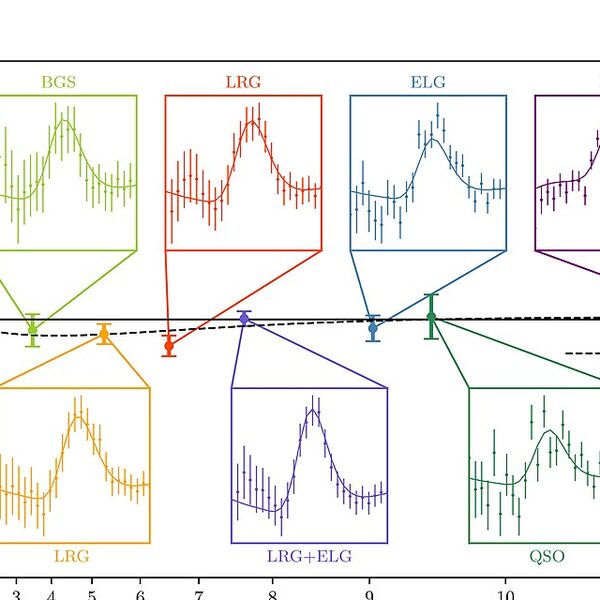
DESI’s BAO measurements against lookback time, one panel per tracer
DESI collaboration/A. de Mattia · CC BY 4.0 · Source (opens in a new tab)
The physics
Before recombination, each overdensity in the photon–baryon plasma drove a pressure wave outwards, carrying the baryons with it. When the Universe became neutral the photons escaped and the wave stalled, leaving extra baryons on a shell at a fixed comoving radius around each overdensity. Matter later clustered around both the centres and the shells, so galaxies today are slightly more likely to be separated by that radius than by nearby distances. It shows up as a peak in the galaxy correlation functioncorrelation functionThe excess probability, over a random distribution, of finding two objects at a given separation. BAO appear as a peak near 100 h−1 Mpc. Its monopole gives the angle-averaged scale, and its quadrupole the difference between the scales along and across the line of sight. and as oscillations in the power spectrum.
The radius is the sound horizonsound horizonThe comoving distance a sound wave in the photon–baryon plasma travelled before baryons decoupled from photons, about 150 Mpc. It is the standard ruler of BAO, so measured distances are quoted relative to it (DM/rd, DH/rd)., the comoving distance a pressure wave travels before recombination, about 150 Mpc. It depends only on the sound speed and the expansion rate in the early Universe:
rs = ∫ cs(t) dta(t)
integrated from the Big Bang to recombination; BAO analyses use its value at the drag epoch, when the baryons were released, written rd
A survey records angles and redshifts. Across the line of sight the scale subtends an angle that gives the comoving distance DM(z)/rd; along it, the scale spans a redshift interval that gives the Hubble distance DH(z)/rd. When the signal is weak, the best-measured combination is the averaged distance DV:
DH(z) = cH(z), DV(z) = [z DM2(z) DH(z)]1/3
Because BAObaryon acoustic oscillationsA preferred separation of about 150 Mpc (comoving) in the galaxy distribution, imprinted by sound waves in the early Universe. Measuring it at many redshifts traces the expansion history like a standard ruler. measures distances in units of rd, it gives the shape of the expansion history like supernovae do, but its distances become absolute once rd is known, from the CMBcosmic microwave backgroundThermal radiation released about 370,000 years after the Big Bang, now at 2.7255 K and peaking near 160 GHz. Its temperature and polarisation anisotropies, at the 10−5 level, constrain the content and geometry of the Universe. or from the baryon density via BBNBig Bang nucleosynthesisThe formation of deuterium, helium and lithium in the first few minutes. The abundances depend on the baryon-to-photon ratio and the expansion rate, so primordial deuterium measures the baryon density and helium-4 constrains the number of light relativistic species.. BAO alone measures Ωm; with the CMB or BBN it gives H0Hubble constantThe present expansion rate, in km s−1 Mpc−1. The local distance ladder gives about 73 and the CMB, under ΛCDM, about 67; the difference, more than 5σ, is the Hubble tension.; with supernovae, dark energydark energyWhatever drives the accelerating expansion of the Universe, about 69% of its energy density today. Measured through expansion history (supernovae, BAO) and the growth of structure (weak lensing, clustering).. Its precision also grows at high redshift, where there is more volume to map.
How it is measured
BAO needs the three-dimensional positions of millions of objects, so it needs spectroscopic redshifts over thousands of square degreessquare degreeUnit of solid angle: one degree by one degree on the sky. The whole sky is about 41,253 deg2; the full Moon covers about 0.2 deg2.. A survey first images the sky to choose targets, galaxies of several types and quasars at higher redshift, then takes thousands of spectra at once with a multi-object spectrographmulti-object spectroscopyTaking spectra of many chosen targets in one field at once, through fibres placed by robotic positioners (DESI, SDSS-V) or through programmable slits and shutters (JWST NIRSpec). The basis of redshift surveys.: DESI places 5,000 robotic fibres on the Mayall 4 m telescope.
Beyond z ≈ 2 galaxies are too faint, and BAO is measured in the Lyman-α forestLyman-α forestThe dense series of absorption lines blueward of Lyman-α (121.6 nm rest) in a distant quasar's spectrum, one for each intervening cloud of neutral hydrogen. It maps the intergalactic gas, and BAO in it, at z ≈ 2–4.: absorption by intergalactic hydrogen along the lines of sight to quasars, each giving tens or hundreds of samples of the density field. The forest measures H(z) best, because redshift-space distortionsredshift-space distortionsAnisotropy in the clustering of galaxies mapped by redshift, caused by their peculiar velocities falling into structures. Measures the growth rate of structure. enhance its clustering along the line of sight.
The scale is set by linear physics, so BAO is robust to most astrophysical systematicssystematicsErrors that do not shrink with more data, because they come from the instrument, the astrophysics or the analysis rather than from counting: detector gains and beams, the standardisation of supernovae, the modelling of how galaxies trace matter. Analyses estimate them and add them to the covariance., and even the largest surveys are expected to be limited by statistics. A survey that maps a volume V densely measures DM to about 0.5% per 10 Gpc3 and H(z) to about 1.7 times that, so precision comes from mapping more volume.
Current results
- Matter density in flat ΛCDM, from DESI DR2 BAO alone (DESI Collaboration 2025)
- Ωm = 0.2975 ± 0.0086
- Preference for evolving dark energy over ΛCDM, DESI DR2 with the CMB
- 3.1σ
- Sum of neutrino masses in ΛCDM, DESI DR2 with the CMB
- Σmν < 0.064 eV (95%)
- Tension between the ΛCDM parameters DESI DR2 prefers and those the CMB prefers
- 2.3σ
DESI DR2 measures BAO from more than 14 million galaxies and quasars and from the Lyman-α forest of over 820,000 quasars, in its first three years. The distances agree with DESI DR1 and SDSS and are well described by flat ΛCDMΛCDMThe standard cosmological model: a flat universe with dark energy as a cosmological constant (Λ), cold dark matter and ordinary matter, fit by six parameters., with Ωm = 0.2975 ± 0.0086, but the preferred parameters are in mild 2.3σ tension with the CMB.
Evolving dark energy, with w0 > −1 and wa < 0, fits better: it is preferred at 3.1σ for DESI with the CMB, and at 2.8σ–4.2σ when supernovae are added, depending on the sample. With the CMB, DESI sets Σmν < 0.064 eVelectronvoltThe energy an electron gains across 1 volt, 1.602 × 10⁻¹⁹ J. High-energy astronomy labels photons by energy: optical light is about 1.7–3.1 eV, X-rays 0.1–100 keV, gamma rays from about 100 keV to beyond 100 TeV. A 1 keV photon has wavelength 1.24 nm. (95%) in ΛCDM, close to the minimum that neutrinoneutrinoA nearly massless, neutral particle that interacts only weakly, so it escapes dense sources and crosses the Universe undeflected. High-energy astrophysical neutrinos point back to where cosmic rays are accelerated. oscillations allow; the bound loosens to 0.16 eV if dark energy evolves.
Before DESI, the completed SDSS lineage (SDSS, BOSS and eBOSS) gave eight BAO samples, enough on their own to rule out models without dark energy at more than 8σ when curvature is free. Euclid's spectroscopic BAO results are still to come.
Experiments and datasets
DESI
More than 14 million galaxies and quasars
And the Lyman-α forest of over 820,000 quasars, z = 0.1–4.2
DESI DR2 BAO2025
Ωm = 0.2975 ± 0.0086
SDSS
The 2.5 m Sloan telescope at Apache Point
1.5 million luminous galaxies to z = 0.7, 2009–2014
Galaxies and quasars at 0.6 < z < 3.5, 2014–2019
Eight samples of galaxies, quasars and the Lyman-α forest
Two decades of spectroscopy
SDSS DR16 BAO2020
Replaced by DESI DR2 BAO
Open questions
Evolving dark energy
DESI DR2 BAO with the CMB prefers dark energy that changes with time (w0 > −1, wa < 0) over a cosmological constant at 3.1σ, and at 2.8σ–4.2σ when supernovae are added, depending on the sample. The recalibrated and combined supernova samples give 3.2σ (DES-Dovekie) and 3.3σ (Unite), which Bayesian evidenceBayesian evidenceThe probability of the data under a model, averaged over its parameters with their priors. The ratio for two models says which the data prefer, with a penalty for extra parameters set by the priors; on the scale DES uses, |Δ ln Z| between 1 and 2.5 is weak evidence. counts as only a weak preference. Euclid, Rubin and Roman will test this with independent data.
Neutrino mass
Massive neutrinos slow the growth of structure, so cosmology weighs them. DESI BAO with the CMB sets Σmν < 0.064 eV (95%) in ΛCDM, close to the minimum of about 0.06 eV that neutrino oscillations require. The bound loosens to 0.16 eV if dark energy evolves.
ProbesBAOCMB temperature and polarisationCMB gravitational lensing
Key papers
- 2026Dark Energy (opens in a new tab)
Weinberg and White · Review of Particle Physics
The standard review: how BAO measures distances, what limits it, and what it finds with supernovae and the CMB.
- 2025DESI DR2 Results II: Measurements of Baryon Acoustic Oscillations and Cosmological Constraints (opens in a new tab)
DESI Collaboration · Phys. Rev. D 112, 083515
BAO from DESI's first three years, and the preference for evolving dark energy.
- 2021The Completed SDSS-IV extended Baryon Oscillation Spectroscopic Survey: Cosmological Implications from two Decades of Spectroscopic Surveys at the Apache Point observatory (opens in a new tab)
eBOSS Collaboration · Phys. Rev. D 103, 083533
The completed SDSS BAO measurements, from eight samples over two decades.