The distance ladderdistance ladderDistances built in steps. Geometric distances (parallaxes, masers, eclipsing binaries) calibrate standard stars such as Cepheid variables, whose period–luminosity relation calibrates Type Ia supernovae in nearby galaxies, which then reach the Hubble flow. measures the Hubble constantHubble constantThe present expansion rate, in km s−1 Mpc−1. The local distance ladder gives about 73 and the CMB, under ΛCDM, about 67; the difference, more than 5σ, is the Hubble tension. directly, from the distances and recession velocities of galaxies. Geometric distances to nearby stars calibrate stars of known luminosity, those stars calibrate Type Ia supernovaetype Ia supernovaThe thermonuclear explosion of a white dwarf. Peak luminosity, standardised by light-curve width and colour, gives distances to about 6%; the Hubble diagram of SNe Ia revealed the accelerating expansion in 1998. in the same galaxies, and the supernovae carry the scale out to where the expansion dominates.
- Measures
- Absolute distances, and from them H0
- When
- z < 0.15
- Constrains
- on its own
- H0 Hubble constant
Get the data
- Pantheon+ and SH0ES (opens in a new tab)
Cepheid and supernova distances, covariances and the H0 likelihood
- Local Distance Network (opens in a new tab)
Every input distance, the supernova covariances and the code that fits the network
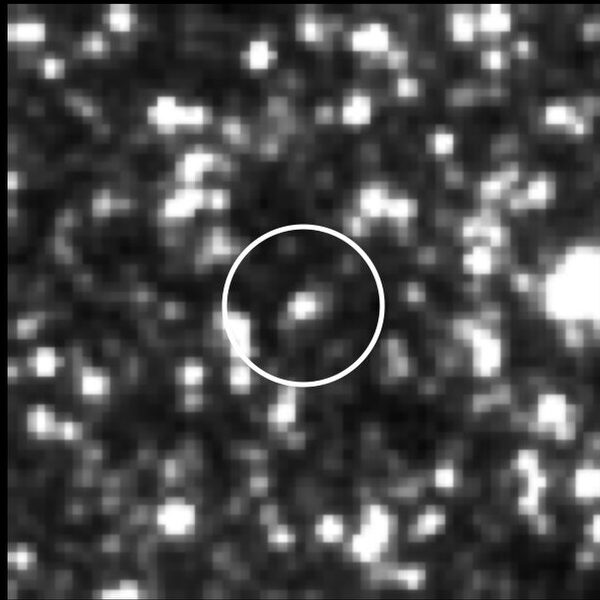
A Cepheid in a supernova host galaxy, seen by Webb
NASA, ESA, CSA, STScI, A. Riess (JHU/STScI) · CC BY 4.0 · Source (opens in a new tab)
The physics
The Hubble constant is the present expansion rate: the slope of the relation between a galaxy's recession velocity and its distance. Nearby galaxies also move under the pull of their neighbours, so the relation is measured in the Hubble flowHubble flowThe regime where galaxies recede mainly because of cosmic expansion rather than their own peculiar motions, so recession velocity is close to H0 times distance. Distance-ladder measurements of H0 use supernovae from about z ≈ 0.02 outwards., far enough away that these peculiar velocitiespeculiar velocityA galaxy's motion relative to the Hubble flow, a few hundred km s−1, which adds to its redshift. It matters most for nearby supernovae: analyses correct redshifts with velocity maps reconstructed from galaxy surveys (2M++) and add an uncertainty of about 250 km s−1 for what remains. are small next to the expansion:
cz ≈ H0 d
for z ≪ 1; at larger redshift the distance depends on the expansion history as well
Redshiftsredshiftz = λobserved/λemitted − 1, the stretching of light by cosmic expansion (or by recession). For distant sources it stands in for distance and look-back time: z ≈ 1 is about 8 Gyr ago, z ≈ 10 about 13.3 Gyr. are easy to measure; distances are not. Each rung of the ladder calibrates the next. The first rung is geometric: parallaxesparallaxThe apparent annual shift of a nearby star as Earth orbits the Sun. A parallax of 1″ means a distance of 1 parsec (3.26 light years); distance in pc is 1/parallax in arcseconds. of stars in the Milky Way from Gaia, detached eclipsing binariesdetached eclipsing binaryA pair of stars that eclipse each other without exchanging mass. The light curve and radial velocities give the stars' radii, a relation between surface brightness and colour gives their angular sizes, and the ratio gives a near-geometric distance; 20 such binaries fix the distance to the Large Magellanic Cloud to about 1%. in the Large Magellanic Cloud, and water masersmaser distanceA geometric distance from water masers orbiting the black hole at a galaxy's centre. Radio interferometry maps the masers' positions, velocities and accelerations in a Keplerian disc, giving its physical and angular size; NGC 4258's distance is known this way to 1.5%, and megamasers in more distant galaxies reach the Hubble flow. orbiting the black hole in NGC 4258. These calibrate standard stars: Cepheid variables, whose pulsation period predicts their luminosity, the tip of the red giant branchtip of the red giant branchThe sharp upper limit in brightness of red giants, reached when helium ignites in the cores of low-mass stars. Its luminosity in the I band is nearly the same in every old stellar population, so it is a standard candle for nearby galaxies and a rung of the distance ladder independent of Cepheids. (TRGB), and J-region asymptotic giant branchJ-region asymptotic giant branchCarbon-rich asymptotic giant branch stars in a narrow range of near-infrared colour, whose mean J-band luminosity is nearly constant. They serve as a standard candle in the outer discs of nearby galaxies, alongside Cepheids and the TRGB. (JAGB) stars. Those stars, measured in galaxies that have hosted Type Ia supernovae, calibrate the supernovae's peak luminosity, and supernovae in the Hubble flow then give H0.
The measurement is local and almost independent of the cosmological model. The CMBcosmic microwave backgroundThermal radiation released about 370,000 years after the Big Bang, now at 2.7255 K and peaking near 160 GHz. Its temperature and polarisation anisotropies, at the 10−5 level, constrain the content and geometry of the Universe. predicts H0 only through a model, ΛCDMΛCDMThe standard cosmological model: a flat universe with dark energy as a cosmological constant (Λ), cold dark matter and ordinary matter, fit by six parameters., so comparing the two tests that model. The disagreement between them is the Hubble tension.
How it is measured
Every calibrating galaxy must have hosted a nearby Type Ia supernova, which is rare: SH0ES uses the hosts of 42 supernovae, every suitable one at z < 0.01 in 40 years. In these galaxies the stars are faint and crowded, so their light has to be separated from that of their neighbours; JWST's sharper near-infrared images now test the Hubble photometryphotometryMeasuring the flux of a source in a passband. Aperture photometry sums pixels inside a region; PSF photometry fits the point-spread function; forced photometry measures at a position fixed in advance, whether or not a source is detected there..
The other limits are the dependence of each kind of standard star on its metallicitymetallicityThe fraction of a star's or galaxy's gas in elements heavier than helium, which astronomers call metals. The luminosities of Cepheids and other standard stars depend slightly on it, so ladder analyses correct for the different metallicities of the anchors and the supernova hosts., the calibrationcalibrationRemoving instrument signatures and putting data in physical units. For images: subtracting bias and dark current, dividing by the flat field (pixel-to-pixel sensitivity), correcting non-linearity and fitting the astrometric solution. For CMB maps: the gain of each detector and channel; CMB likelihoods fit the small calibration differences between spectra as nuisance parameters. For supernovae: putting every survey's photometry on one magnitude system, so distances from different telescopes can be compared. between instruments and between rungs, and which supernova hosts are used. Different standard stars share the supernova rung, so comparing Cepheids with the TRGB and JAGB stars in the same galaxies is the main test.
Current results
- Every distance indicator combined with its correlations (Local Distance Network, H0DN 2026)
- H0 = 73.50 ± 0.81 km s−1 Mpc−1
- Cepheids in 42 supernova hosts (SH0ES, Riess et al. 2022)
- H0 = 73.04 ± 1.04 km s−1 Mpc−1
- The TRGB with Hubble and JWST, statistical, systematic and supernova errors (CCHP, Freedman et al. 2025)
- H0 = 70.39 ± 1.22 ± 1.33 ± 0.70 km s−1 Mpc−1
- The Local Distance Network's distance from flat ΛCDM fitted to Planck, SPT and ACT
- 7.1σ
SH0ES measures Cepheids with Hubble in the hosts of 42 supernovae and gives H0 = 73.04 ± 1.04 km s−1 MpcparsecThe distance at which 1 AU subtends 1″: 3.086 × 10¹⁶ m, or 3.26 light years. Galaxies are measured in Mpc.−1, 5σ from Planck with ΛCDM. JWST imaging of more than 1,000 Cepheids rejects crowdingcrowdingSources close enough that their PSFs overlap, so flux is shared between them. Pipelines with large pixels (TESS's are 21″) need careful deblending or difference imaging in dense fields. of the Hubble photometry as the cause at 8σ.
CCHP calibrates 24 supernovae with the TRGB from Hubble and JWST and finds H0 = 70.39 ± 1.22 (stat) ± 1.33 (sys) ± 0.70 (σSN); from JWST alone, 68.81 with the TRGB and 67.80 with JAGB stars.
The Local Distance Network, a covariancecovariance matrixThe uncertainties of a measured statistic and how they correlate between its points (redshift bins, multipoles). Systematic errors, such as a shared calibration, enter as off-diagonal terms; fitting without them overstates the precision.-weighted combination of every indicator reviewed by the community, gives H0 = 73.50 ± 0.81 km s−1 Mpc−1, 7.1σ from flat ΛCDM fitted to Planck, SPT and ACT. Removing either the Cepheids or the TRGB has little effect on the value.
Experiments and datasets
Cepheids
Gaia
Parallaxes of Milky Way Cepheids
Cepheids in supernova hosts
More than 1,000 Cepheids, to test crowding
Cepheids in the hosts of 42 supernovae
Anchored by parallaxes, the LMC and NGC 4258
H0 = 73.04 ± 1.04
Red giants
TRGB and JAGB stars
The TRGB in 20 hosts of 24 supernovae, JAGB stars in 7 hosts of 8
H0 = 70.39 ± 1.22 (stat) ± 1.33 (sys) ± 0.70 (σSN)
Combined
The Cepheid and TRGB distances of both routes, other teams' TRGB distances, SBF and megamasers
One network of distances
Hosts of 55 supernovae, fitted together with the correlations between shared anchors and hosts
H0 = 73.50 ± 0.81
Open questions
Hubble constant
Measured locally, the expansion rate is higher than the CMB predicts. The distance ladder gives H0 = 73.04 ± 1.04 km s−1 Mpc−1 with Cepheids (SH0ES) and 73.50 ± 0.81 combining every indicator (the Local Distance Network), but 70.39 ± 1.22 (stat) ± 1.33 (sys) ± 0.70 (σSN) with the tip of the red giant branch (CCHP). The CMB under ΛCDM gives 67.4 ± 0.5 (Planck), and SPT-3G alone 66.66 ± 0.60, 6.2σ from SH0ES. Standard sirensstandard sirenA gravitational-wave source whose luminosity distance follows from its waveform alone, with no distance ladder. The redshift comes from an electromagnetic counterpart (bright siren), from galaxies in the localisation volume (dark siren) or from features of the mass distribution (spectral siren); distance against redshift gives H0., at 71.7 (+9.4, −7.5), are not yet precise enough to decide.
ProbesDistance ladderCMB temperature and polarisationGravitational-wave standard sirens
Key papers
- 2026Cosmological Parameters (opens in a new tab)
Cortês, Lahav and Liddle · Review of Particle Physics
The standard review; its section on H0 sets the ladder beside the CMB, BAO, lensing and sirens.
- 2026The Local Distance Network: a community consensus report on the measurement of the Hubble constant at 1% precision (opens in a new tab)
H0DN Collaboration · A&A 708, A166
Combines every distance indicator with its correlations, and tests how much each one matters.
- 2022A Comprehensive Measurement of the Local Value of the Hubble Constant with 1 km/s/Mpc Uncertainty from the Hubble Space Telescope and the SH0ES Team (opens in a new tab)
Riess et al. · ApJL 934, L7
SH0ES: Cepheids in 42 supernova hosts give H0 = 73.04 ± 1.04 km s−1 Mpc−1.
- 2025Status Report on the Chicago-Carnegie Hubble Program (CCHP): Measurement of the Hubble Constant Using the Hubble and James Webb Space Telescopes (opens in a new tab)
Freedman et al. · ApJ 985, 203
The TRGB and JAGB route, which gives a lower H0 than Cepheids.
- 2024JWST Observations Reject Unrecognized Crowding of Cepheid Photometry as an Explanation for the Hubble Tension at 8σ Confidence (opens in a new tab)
Riess et al. · ApJL 962, L17
JWST images of more than 1,000 Cepheids rule out crowding as the cause of the tension.
Sources
- Cortês, Lahav and Liddle, Cosmological Parameters (PDG 2026) (opens in a new tab)
- Weinberg and White, Dark Energy (PDG 2026) (opens in a new tab)
- H0DN Collaboration 2025 (arXiv) (opens in a new tab)
- Riess et al. 2022 (arXiv) (opens in a new tab)
- Freedman et al. 2025 (arXiv) (opens in a new tab)
- Riess et al. 2024 (arXiv) (opens in a new tab)
Checked 22 November 2026.