Merging neutron stars and black holes emit gravitational waves whose loudness tells us how far away they are, with no distance ladderdistance ladderDistances built in steps. Geometric distances (parallaxes, masers, eclipsing binaries) calibrate standard stars such as Cepheid variables, whose period–luminosity relation calibrates Type Ia supernovae in nearby galaxies, which then reach the Hubble flow.. Combined with a redshiftredshiftz = λobserved/λemitted − 1, the stretching of light by cosmic expansion (or by recession). For distant sources it stands in for distance and look-back time: z ≈ 1 is about 8 Gyr ago, z ≈ 10 about 13.3 Gyr., from a flash of light, from the galaxies around the source or from the masses of the population, each mergercompact binary coalescenceThe inspiral and merger of two black holes, two neutron stars or one of each. The signal sweeps up in frequency and amplitude (a chirp) until the objects merge; its shape gives their masses, spins and distance. is a point on the distance–redshift relation.
- Measures
- Luminosity distance from the waveform
- When
- z ≲ 1
- Constrains
- on its own
- H0 Hubble constant
- Gravity tests of general relativity
Get the data
- GWOSC (opens in a new tab)
Strain data, event catalogues and posterior samples
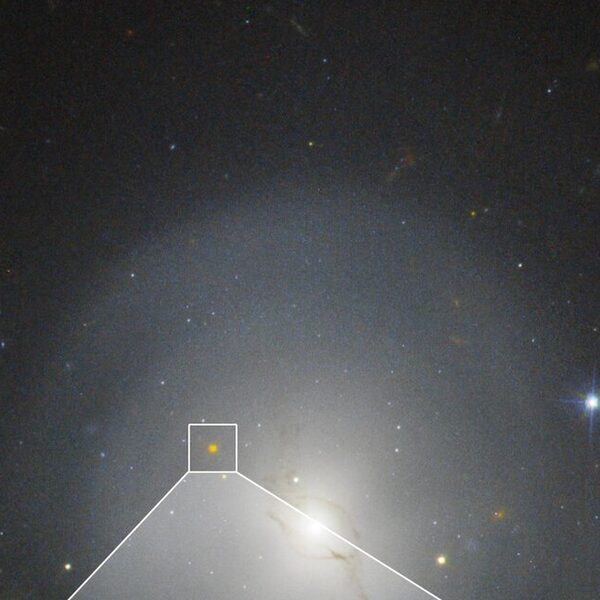
The kilonova of GW170817 in NGC 4993 (Hubble)
NASA and ESA. Acknowledgment: A.J. Levan (U. Warwick), N.R. Tanvir (U. Leicester), and A. Fruchter and O. Fox (STScI) · CC BY 4.0 · Source (opens in a new tab)
The physics
Two compact objects spiralling together emit gravitational waves whose frequency rises as they approach. How fast the frequency rises fixes the binary's chirp masschirp massThe combination of a binary's two masses, (m1 m2)3/5/(m1 + m2)1/5, that sets how fast its gravitational-wave frequency rises. The detector measures it redshifted, (1 + z) times the source value, which is why the waveform alone gives no redshift., and with it how strong the waves are at the source. The amplitude measured at Earth then gives the luminosity distanceluminosity distanceThe distance that relates a source's luminosity to the flux received, DL = \sqrt{L/4πF}; in an expanding Universe it is (1 + z) times the comoving distance. Supernovae measure it relative to one another, standard sirens absolutely from their waveforms. directly, which is why such sources are called standard sirensstandard sirenA gravitational-wave source whose luminosity distance follows from its waveform alone, with no distance ladder. The redshift comes from an electromagnetic counterpart (bright siren), from galaxies in the localisation volume (dark siren) or from features of the mass distribution (spectral siren); distance against redshift gives H0.:
h ∝ Mc5/3 f2/3DL
the strain amplitude h at frequency f, for chirp mass Mc as measured in the detector
The waveform does not give the redshift: a binary's masses and its redshift enter only as their product, (1 + z) Mc. The redshift has to come from elsewhere. A bright siren has a counterpart in light, as the neutron-star merger GW170817 had, whose host galaxy has a known redshift. A dark siren is matched statistically against the galaxies in the volume where the source could lie. A spectral siren uses features in the mass distribution of the whole population, whose positions in the detector frame shift with redshift.
Distance against redshift gives H0Hubble constantThe present expansion rate, in km s−1 Mpc−1. The local distance ladder gives about 73 and the CMB, under ΛCDM, about 67; the difference, more than 5σ, is the Hubble tension. for nearby sources and the expansion history for distant ones. The same waves also test gravity. GW170817 arrived almost together with its light, showing that gravitational waves travel at almost exactly the speed of light, and a difference between the distances measured by gravitational waves and by light would signal modified gravity.
How it is measured
A passing gravitational wave stretches and squeezes space by a tiny fraction, measured by laser interferometersinterferometryCombining waves from separate receivers coherently. In radio and optical astronomy, correlating signals from separated telescopes gives the resolution of one as large as their separation. In gravitational-wave detection, a laser Michelson interferometer measures tiny differential changes in its arm lengths. with arms kilometres long: LIGO's two detectors at Hanford and Livingston, 3,000 km apart, with 4 km arms; Virgo near Pisa, with 3 km arms; and KAGRA, underground in the Kamioka mine, with 3 km arms. Several detectors together locate a source on the sky from the differences in arrival time and amplitude.
The distance from a single event is uncertain, mainly because it is degenerate with how the orbit is tilted to our line of sight: a face-on binary far away looks like an edge-on one nearby. Precision therefore comes from many events.
So far a single source has had a counterpart. Dark sirens need galaxy catalogues that are complete over each source's localisation volume, such as GLADE+GLADE+An all-sky compilation of about 22 million galaxies from six catalogues, built for gravitational-wave follow-up. The dark-siren analyses use its roughly one million Ks-band galaxies, wide but shallow, as possible hosts. or the DES Year 6 galaxies, and spectral sirens need a model of the black-hole mass distribution. Both bring systematic errorssystematicsErrors that do not shrink with more data, because they come from the instrument, the astrophysics or the analysis rather than from counting: detector gains and beams, the standardisation of supernovae, the modelling of how galaxies trace matter. Analyses estimate them and add them to the covariance. from those models.
Current results
- 235 dark sirens with DES Year 6 galaxies, and GW170817 (GWTC-5.0, LIGO, Virgo and KAGRA 2026)
- H0 = 71.7 (+9.4, −7.5) km s−1 Mpc−1
- GW170817 and its host galaxy alone (Abbott et al. 2017)
- H0 = 70.0 (+12.0, −8.0) km s−1 Mpc−1
- 141 dark sirens with the GLADE+ galaxy catalogue, and GW170817 (GWTC-4.0, 2026)
- H0 = 75.4 (+12.8, −9.1) km s−1 Mpc−1
GW170817 alone gave H0 = 70.0 (+12.0, −8.0) km s−1 MpcparsecThe distance at which 1 AU subtends 1″: 3.086 × 10¹⁶ m, or 3.26 light years. Galaxies are measured in Mpc.−1. GWTC-4.0 combines 141 dark sirens with the GLADE+ galaxy catalogue and GW170817 for H0 = 75.4 (+12.8, −9.1). GWTC-5.0 combines 235 dark sirens with DES Year 6 galaxies and GW170817 for H0 = 71.7 (+9.4, −7.5), an uncertainty 22.0% smaller. In GWTC-5.0 the dark sirens alone, 68.8 (+14.2, −13.2), are for the first time tighter than GW170817 alone. Most of their information still comes from the mass distribution: spectral sirens alone give 70.1 (+15.1, −13.3), and the galaxies tighten that by 3.5%.
At this precision, sirens cannot yet choose between the CMBcosmic microwave backgroundThermal radiation released about 370,000 years after the Big Bang, now at 2.7255 K and peaking near 160 GHz. Its temperature and polarisation anisotropies, at the 10−5 level, constrain the content and geometry of the Universe. value of H0 and the distance ladder's. The uncertainty shrinks as the number of events grows.
Experiments and datasets
Many mergers
236 compact-binary mergers
Redshift information mostly from the mass distribution; DES Year 6 galaxies tighten H0 by 3.5%
H0 = 71.7 (+9.4, −7.5)
Bright siren
LIGO and Virgo, and the telescopes that found its light
GW170817 and its kilonova
A neutron-star merger in the galaxy NGC 4993
GW1708172017
H0 = 70.0 (+12.0, −8.0)
Open questions
Hubble constant
Measured locally, the expansion rate is higher than the CMB predicts. The distance ladder gives H0 = 73.04 ± 1.04 km s−1 Mpc−1 with Cepheids (SH0ES) and 73.50 ± 0.81 combining every indicator (the Local Distance Network), but 70.39 ± 1.22 (stat) ± 1.33 (sys) ± 0.70 (σSN) with the tip of the red giant branchtip of the red giant branchThe sharp upper limit in brightness of red giants, reached when helium ignites in the cores of low-mass stars. Its luminosity in the I band is nearly the same in every old stellar population, so it is a standard candle for nearby galaxies and a rung of the distance ladder independent of Cepheids. (CCHP). The CMB under ΛCDMΛCDMThe standard cosmological model: a flat universe with dark energy as a cosmological constant (Λ), cold dark matter and ordinary matter, fit by six parameters. gives 67.4 ± 0.5 (Planck), and SPT-3G alone 66.66 ± 0.60, 6.2σ from SH0ES. Standard sirens, at 71.7 (+9.4, −7.5), are not yet precise enough to decide.
ProbesDistance ladderCMB temperature and polarisationGravitational-wave standard sirens
Key papers
- 2026Cosmological Parameters (opens in a new tab)
Cortês, Lahav and Liddle · Review of Particle Physics
The standard review; its section on H0 compares sirens with the ladder, lensing and the CMB.
- 2017A gravitational-wave standard siren measurement of the Hubble constant (opens in a new tab)
Abbott et al. · Nature 551, 85
The first standard siren: GW170817 and its host galaxy give H0 = 70.0 (+12.0, −8.0) km s−1 Mpc−1.
- 2026GWTC-4.0: Constraints on the Cosmic Expansion Rate and Modified Gravitational-wave Propagation (opens in a new tab)
LIGO, Virgo and KAGRA Collaborations · ApJL 1007, L17
141 dark sirens with the GLADE+ galaxy catalogue and GW170817, and limits on modified gravitational-wave propagation.
- 2026GWTC-5.0: Constraints on the Cosmic Expansion Rate and Modified Gravitational-wave Propagation (opens in a new tab)
LIGO, Virgo and KAGRA Collaborations
235 dark sirens with DES Year 6 galaxies and GW170817, 22.0% tighter than GWTC-4.0.
Sources
- Cortês, Lahav and Liddle, Cosmological Parameters (PDG 2026) (opens in a new tab)
- Weinberg and White, Dark Energy (PDG 2026) (opens in a new tab)
- LIGO facts (opens in a new tab)
- The Virgo detector (opens in a new tab)
- KAGRA (opens in a new tab)
- Abbott et al. 2017 (arXiv) (opens in a new tab)
- GWTC-4.0 cosmology (arXiv v3) (opens in a new tab)
- GWTC-5.0 cosmology (arXiv v2) (opens in a new tab)
- GWTC-5.0 results (arXiv) (opens in a new tab)
Checked 22 November 2026.