The deuterium and helium in the Universe were made in the first few minutes after the Big Bang. How much of each formed depends on the density of baryons and on how fast the Universe was expanding, so measuring the primordial abundances today constrains the baryon density and the number of light particle species.
- Measures
- Primordial D/H and the helium-4 mass fraction Yp
- When
- From about one second to a few minutes after the Big Bang
- Constrains
- on its own
- Ωb h2 baryon density
- Neff effective number of neutrino species
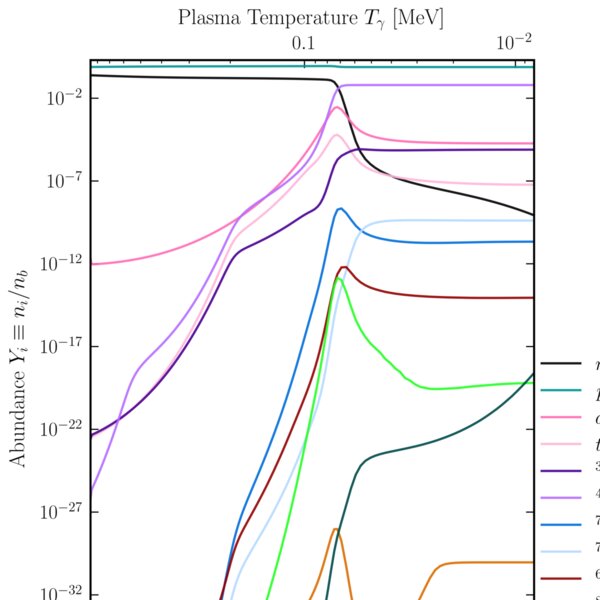
Light-element abundances against time in the first hours
MyxococcusFruitingBody · CC BY 4.0 · Source (opens in a new tab)
The physics
About one second after the Big Bang, at a temperature near 1 MeVelectronvoltThe energy an electron gains across 1 volt, 1.602 × 10⁻¹⁹ J. High-energy astronomy labels photons by energy: optical light is about 1.7–3.1 eV, X-rays 0.1–100 keV, gamma rays from about 100 keV to beyond 100 TeV. A 1 keV photon has wavelength 1.24 nm., the weak interactions that turn neutrons into protons and back became too slow to keep up with the expansion. The neutron-to-proton ratio froze at about 1/6, and free neutrons decaying brought it down to about 1/7 by the time nuclei could form.
Deuterium is the first step in the chain, but at first it could not survive. Its binding energy is 2.23 MeV, yet there are more than a billion photons for every baryon, and enough of them could break it apart until the temperature fell to about 0.1 MeV. Once deuterium survived, nearly all the neutrons were bound into helium-4, the most stable light nucleus, so the helium-4 mass fraction counts the neutrons:
Yp ≈ 2(n/p)1 + n/p ≈ 0.25
The neutron fraction depends on when the freeze happened, and that depends on the expansion rate. Extra light particles, counted by Neffeffective number of neutrino speciesThe energy density of light relativistic particles in the early Universe, in units of one neutrino species: 3.044 for the three Standard Model neutrinos. A higher value would mean extra light particles and a faster early expansion, which BBN and the CMB both constrain., speed up the expansion and raise Yp. Helium-4 hardly depends on the nuclear reaction rates.
Deuterium is what was left unburned, a few parts in 105 relative to hydrogen. The more baryons there are, the faster the reactions that burn it, so D/H falls steeply as the baryon-to-photon ratio η rises. That makes deuterium the best measure of the baryon density:
Ωb h2 ≈ η10274
where η10 = 1010 nb/nγ
How it is measured
Deuterium is measured in absorption. A gas cloud at high redshiftredshiftz = λobserved/λemitted − 1, the stretching of light by cosmic expansion (or by recession). For distant sources it stands in for distance and look-back time: z ≈ 1 is about 8 Gyr ago, z ≈ 10 about 13.3 Gyr. that lies in front of a bright quasar absorbs the quasar's light at the hydrogen Lyman lines, and its deuterium absorbs at slightly shorter wavelengths, shifted by the heavier nucleus. The clouds used have between a thousandth and a few hundredths of the Sun's metallicitymetallicityThe fraction of a star's or galaxy's gas in elements heavier than helium, which astronomers call metals. The luminosities of Cepheids and other standard stars depend slightly on it, so ladder analyses correct for the different metallicities of the anchors and the supernova hosts., so little of their gas has passed through stars and their D/H is close to primordial.
The deuterium lines are weak, sit right beside much stronger hydrogen lines, and are often blendedcrowdingSources close enough that their PSFs overlap, so flux is shared between them. Pipelines with large pixels (TESS's are 21″) need careful deblending or difference imaging in dense fields. with the Lyman-α forestLyman-α forestThe dense series of absorption lines blueward of Lyman-α (121.6 nm rest) in a distant quasar's spectrum, one for each intervening cloud of neutral hydrogen. It maps the intergalactic gas, and BAO in it, at z ≈ 2–4., so only a few systems are clean enough to use. Separating the lines needs high-resolution echelle spectrographsechelle spectrographA spectrograph that uses a coarse grating at high diffraction orders, with a second disperser across them, so many short orders stack on the detector and cover a wide range at high resolving power (tens of thousands). Keck/HIRES and VLT/UVES are examples. on large telescopes, such as HIRES on Keck and UVES on the VLT.
Helium-4 is measured in emission, from the helium and hydrogen lines of ionised gas (H II regionsH II regionA cloud of hydrogen ionised by ultraviolet light from young massive stars, bright in recombination lines such as Hα and in radio free–free emission; a tracer of current star formation.) in the most metal-poor star-forming galaxies, nearby blue compact dwarfs. Stars add helium as they make heavier elements, so only the lowest-metallicity galaxies are close to primordial.
The hard part is the physics of the gas. Its electron density, temperature and reddening by dust all change the line ratios, and these systematic errorssystematicsErrors that do not shrink with more data, because they come from the instrument, the astrophysics or the analysis rather than from counting: detector gains and beams, the standardisation of supernovae, the modelling of how galaxies trace matter. Analyses estimate them and add them to the covariance. dominate. The infrared He I line at 10830 Å depends strongly on density, which helps separate density from temperature.
Current results
- Primordial deuterium, from seven quasar absorbers (Cooke et al. 2018)
- (D/H)p = (2.527 ± 0.030) × 10−5
- Primordial helium-4, from 15 H II regions (Aver et al. 2026)
- Yp = 0.2458 ± 0.0013
- Baryon density, BBN with the CMB, three neutrino species (Yeh et al. 2026)
- Ωb h2 = 0.02236 ± 0.00014
- Number of neutrino species, BBN with the CMB (Yeh et al. 2026)
- Nν = 2.925 ± 0.082
Cooke et al. (2018) added a new near-pristine absorber, at z = 2.526 towards the quasar Q1243+307 with about 1/600 of the Sun's oxygen abundance, to six earlier systems. Together they give (D/H)p to 1%.
The LBT Yp Project observed 54 metal-poor H II regions with the Large Binocular Telescope. A weighted average of the 15 with the lowest metallicity gives Yp to 0.5%. Standard BBNBig Bang nucleosynthesisThe formation of deuterium, helium and lithium in the first few minutes. The abundances depend on the baryon-to-photon ratio and the expansion rate, so primordial deuterium measures the baryon density and helium-4 constrains the number of light relativistic species. with Planck's baryon density predicts 0.2467 ± 0.0002, in good agreement (Aver et al. 2026).
Combined with the CMBcosmic microwave backgroundThermal radiation released about 370,000 years after the Big Bang, now at 2.7255 K and peaking near 160 GHz. Its temperature and polarisation anisotropies, at the 10−5 level, constrain the content and geometry of the Universe., these give Ωb h2 = 0.02236 ± 0.00014 with three neutrinoneutrinoA nearly massless, neutral particle that interacts only weakly, so it escapes dense sources and crosses the Universe undeflected. High-energy astrophysical neutrinos point back to where cosmic rays are accelerated. species. Letting the number vary gives Ωb h2 = 0.02229 ± 0.00016 and Nν = 2.925 ± 0.082, consistent with three (Yeh et al. 2026). BBN and the CMB measure the baryon density minutes and 370,000 years after the Big Bang, so their agreement shows that nothing changed it in between.
Experiments and datasets
Deuterium
Keck
Two 10 m telescopes on Maunakea, Hawaiʻi
HIRES echelle spectrograph, R ≈ 25,000–85,000
VLT
Four 8.2 m telescopes on Cerro Paranal, Chile
UVES echelle spectrograph, R up to 110,000
Quasar absorbers
Deuterium and hydrogen Lyman lines in seven near-pristine gas clouds
Cooke et al. 2018 D/H
(D/H)p = (2.527 ± 0.030) × 10−5
Helium-4
Large Binocular Telescope
Two 8.4 m mirrors on one mount, Pinaleño Mountains, Arizona
Metal-poor H II regions
54 observed; the 15 lowest-metallicity averaged
LBT Yp Project
Yp = 0.2458 ± 0.0013
Both
All deuterium and helium-4 measurements
PDG-recommended abundances
Averages of D/H and Yp in the Review of Particle Physics
Schöneberg 2024. The “+BBN” in BAO results quoted without the CMB.
Ωb h2 = 0.02218 ± 0.00055
CMB
CMB temperature and polarisation
The baryon density 370,000 years after the Big Bang, to compare with BBN's
Planck likelihoods
Three, from the 2018 and PR4 releases
Key papers
- 2024Big Bang Nucleosynthesis (opens in a new tab)
Fields, Molaro and Sarkar · Review of Particle Physics
The standard review: the theory, the observations of each element and the recommended abundances.
- 2026The LBT Yp Project V: Cosmological Implications of a New Determination of Primordial 4He (opens in a new tab)
Yeh et al. · arXiv:2601.22239
Combines the new Yp with deuterium and the CMB to get Ωb h2 and Nν.
- 2026The LBT Yp Project IV: A New Value of the Primordial Helium Abundance (opens in a new tab)
Aver et al. · arXiv:2601.22238
54 H II regions observed with the LBT give Yp to 0.5%.
- 2024The 2024 BBN baryon abundance update (opens in a new tab)
Schöneberg · arXiv:2401.15054
The BBN prior on Ωb h2, and how it depends on the choice of nuclear rates.
- 2018One percent determination of the primordial deuterium abundance (opens in a new tab)
Cooke et al. · ApJ 855, 102
A new absorber towards Q1243+307 and six earlier ones give (D/H)p to 1%.
Sources
- Fields, Molaro and Sarkar, Big Bang Nucleosynthesis (PDG 2024) (opens in a new tab)
- Olive and Peacock, Big-Bang Cosmology (PDG 2026) (opens in a new tab)
- Cooke et al. 2018 (arXiv) (opens in a new tab)
- Aver et al. 2026 (arXiv) (opens in a new tab)
- Yeh et al. 2026 (arXiv) (opens in a new tab)
- Keck telescopes and instruments (opens in a new tab)
- Keck HIRES (opens in a new tab)
- ESO Very Large Telescope (opens in a new tab)
- ESO UVES (opens in a new tab)
- About the LBT (opens in a new tab)
Checked 21 November 2026.